Swiss Army Man was the craziest film we saw at Sundance 2016. (And we saw 22 films, so that’s really, really saying something.) I saw the trailer before my viewing of The Lobster this weekend, and that reminded me that Swiss Army Man is coming to theaters June 24th.
The film begins with Paul Dano trying to hang himself on a deserted island. A dead body (Daniel Radcliffe) washes ashore and begins to fart. Copiously.
Dano rides Radcliffes’ flatulent body like a jet ski off the island. This is the first 10 minutes of the film, and it sets the tone of magical realism. I don’t think I’ve ever been at a Sundance showing at Eccles Theater (the largest venue) with so many walk outs. I was seated 7 rows from the front, and two groups of 4 people in seats in front of ours walked out only half an hour into the film. From an article in Variety, they weren’t the only ones. And this was after there were huge lines of people trying to get in to the showing.
This film was very divisive at the fest. My husband hated it and found it juvenile. My 23 year old son loved it, and gave it four stars (out of four). I think it was his favorite of the whole festival. I was in the middle. I laughed quite a bit, but it wasn’t my favorite, by any means.
The title, Swiss Army Man refers to all the ways that Daniel Radcliffe’s dead body saves Paul Dano’s on their journey back to civilization. Strike a spark, and the farting corpse lights a fire. Dripping rain fills the body with drinkable water (gross!). The body begins to talk, and they have conversations on the meaning of life, and what it means to be alive. It’s philosophical, and crazy weird. The body sees a picture of a girl on Dano’s phone, and his erect penis becomes a compass. Really.
The acting is great, and I have to give kudos to Daniel Radcliffe for his physical work. He had to hold what looked like extremely uncomfortable poses as a dead corpse with a broken neck.
“The Daniels”, the directing duo of Daniel Scheinert and Daniel Kwan, won a special jury prize for directing this film at Sundance. I wasn’t familiar with them before the fest. Evidently, they “broke the internet” with their music video Turn Down For What. Daniel Kwan, one of the directing Daniels duo stars in the music video:
You, dear reader, have the advantage over all those festival goers at the premiere. You can watch the trailer below and decide if this is your kind of movie. It’s certainly one I will never forget.
I adored the absurd surreal film The Lobster. I missed it at Sundance, where it premiered in January. This is a love it or hate it kind of movie. I loved it, but some of the people walking out of my suburban theater HATED it. They really hated it. For me, it was just my cup of tea, and a welcome standout after a string of mediocre films I’ve seen this past week.
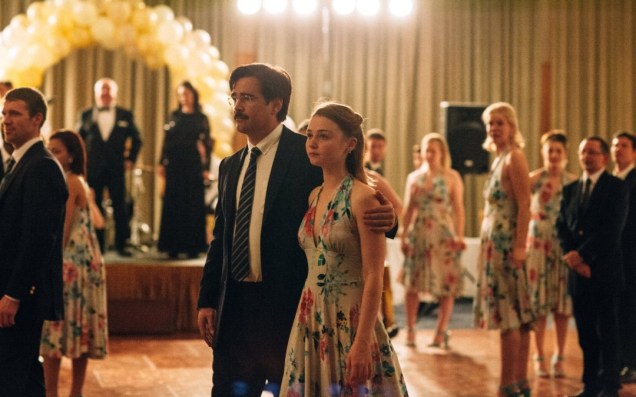
The film opens with a woman driving in the countryside in the rain. She stops her car, gets out and shoots a donkey in a field. Gets back in her car and drives away. It’s never referred to again, but that sets the tone of how absurd this world is that Greek writer/director Yorges Lanthimos has created. We then first see David (Colin Farrell). His wife is breaking up their 12 year marriage for another man. And that means he has to leave immediately to be taken away to “The Hotel” to be paired up with another woman. Singles and loners are not allowed in this near future dystopian world.
When David arrives at The Hotel (in County Kerry, Ireland), the manager (the always exceptional Olivia Colman) explains the rules to him. He has 45 days to find a new mate or he will be turned into an animal. He chooses a lobster, because they can live for 100 years and he’s always liked the sea. “Excellent choice.” He is warned that if he doesn’t find his true mate in time, he cannot couple after he is transformed if she picks another animal. “A wolf and a penguin could not couple because that would be absurd.”
This film is populated by so many of my favorite character actors. Olivia Colman of The Night Manager. John C. Reilly is a man with an unfortunate lisp. Ben Whishaw has a limp. Ashley Jenkins of The Extras is known as “Biscuit Woman”. Couples must come together with the same distinguishing characteristic. Limping Man (Ben Whishaw) bangs his head against tables to get nosebleeds to pair with a woman with that frequent malady. All the single residents of the hotel must go out on hunts into the woods with tranquilizer guns to search for “loners”.
If they catch a loner, they can extend their stay at the hotel. One unfeeling woman has bagged so many loners that she has an extra 160 days. David (Farrell) has brought his brother with him, who has been turned into a dog.
Every one of the actors delivers their lines in a quirky deadpan manner. I think that’s what inspired some of the hate of my fellow viewers at the theater, but I just thought it added to all the absurdity. These actors commit to the bizarre rules of this film world. It borders on absurd comedy, and then there are some sudden scenes of violence or drama. Lisping Man is punished for masturbating in his room, by having his hand forced into a toaster, for instance.
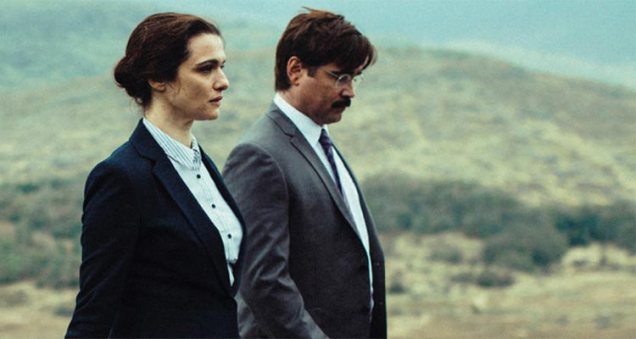
David escapes and becomes part of the Loner band in the forest where he meets Rachel Weisz. They have to pretend to be a couple to venture into the city for supplies, and David enthusiastically falls into the playacting and kissing. The young woman leader of the Loners is just as strict in her no fraternizing rules as the manager of The Hotel had been with her coupling rules. Farrell and Weisz plot together to escape.
The ending was a fade to black that left you hanging a bit, and was my most unsatisfying moment of the film. The rest was just fantastic. Colin Farrell gained 40 pounds for this movie. He has quite the paunch and “dad bod”. I think he relished being more of a character actor leading man in this film. I thought he was so good, as was the always great Rachel Weisz.
This film is not for everyone. But if you love absurd surreal “Sundance” kinds of movies, this will be right up your alley. Four and a half stars out of five.
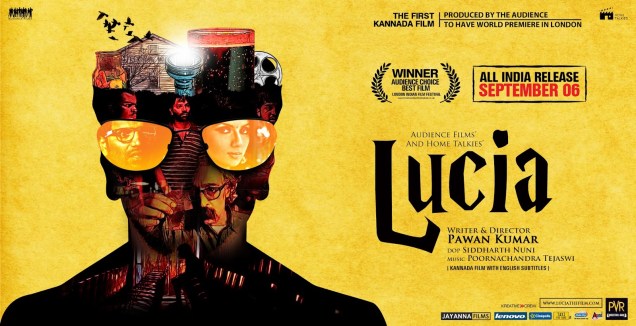
U Turn is a Kannada language supernatural suspense thriller written and directed by Pawan Kumar. Pawan Kumar blew me away with his amazing low budget Kannada film Lucia. Lucia had twist after twist and I never knew what was going to happen next.
U Turn starts upside down. Literally. We see the divider of a road, and the camera travels along it, but upside down as the opening credits roll. Then the camera does a u-turn and continues to travel the urban highway. Throughout the film there are ‘U’s sprinkled around, both in the visual framing of shots, and horseshoe knockers on doors, etc.
Shraddha Srinath, the star of the film, is introduced to us in a really clever way. Rachana (Srinath) is riding in a rickshaw with her mother, and through their arguing we learn that she’s single, that her mother is pressuring her to marry, that her family is going away on a trip, and thus she will be alone. It’s a really clever bit of writing. She draws the rickshaw driver into the argument, showing us a bit of her moxie and personality.
Rachana is an intern reporter at The Indian Express. She’s working on a story about people who make illegal u-turns on the flyover highway, moving the divider bricks out of the way, but not returning them after they make the turn. She has a homeless guy at the intersection writing down their license plate numbers. She goes to interview one of the drivers but he doesn’t answer the door.
Later that night after she is dropped off from her first date with the crime reporter, Aditya (Dilip Raj), the police come and arrest her.
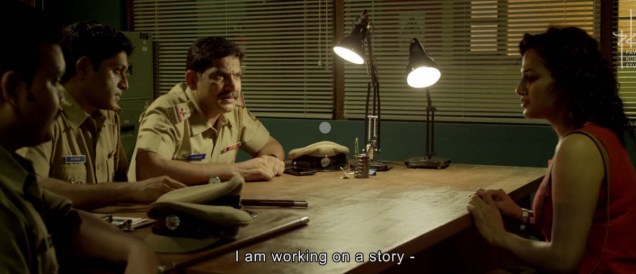
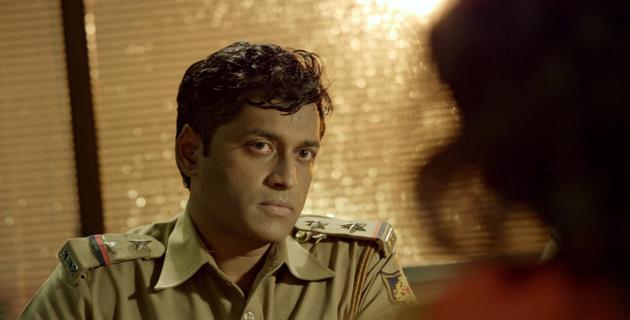
The police interrogate her as she had written her name in the visitor book, and is the last person to visit a man, found hung in his apartment. They don’t believe her at first that she is a reporter and working on an investigative story. Finally, the young cop, Nayak, listens and checks out her version of events.
Roger Narayan played Nayak and he was my favorite actor in the whole movie. He was great, and had a lot of subtle reactions. You can tell he has a bit of a crush on Rachana, but he plays someone trying to hold it back, but still let’s you see it.
I admire Pawan Kumar for turning some conventions on their head. Rachana is the active heroine of the script, and later her boyfriend Aditya takes on the ‘damsel in distress’ role, and she tries to save him. Shraddha Srinath did a good job carrying the film, and while he doesn’t have as much screen time, Dilip Raj shone in his supporting role.
I saw U Turn in a theater, and while there were a few jumps that scared me, the film just didn’t have enough suspense or thrills for me. It’s based on a real incident, evidently, but the film did not have the magic of Lucia for me.
Part of the problem was the score. The background music is critical in a suspense film, and this music just did not evoke the creepiness or scariness that it should. The recent low budget Tamil film Pizzahad not only music but a soundscape that added greatly to the creepiness.
Don’t believe me what a difference music and soundscape can make? Watch this Scary Mary Poppins trailer with some different music:
U Turn is a good film, but it just wasn’t as scary and creepy as I was hoping it would be, or as mind-bending as Lucia.
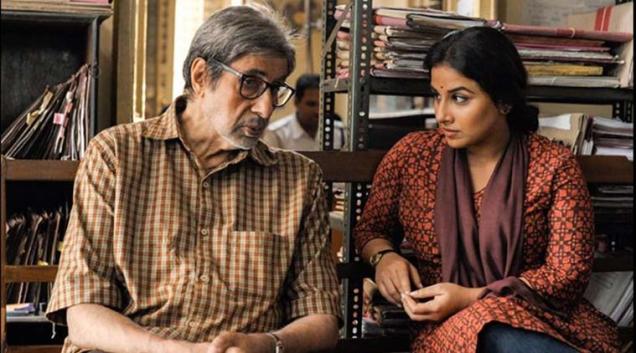
Te3n is a Hindi thriller starring Amitabh Bachchan as the grandfather of a young girl who was kidnapped and killed 8 years ago. He can’t let the unsolved case go, and visits the police station every day for an update. Vidya Balan is the police detective who tries to gently get him to move on.
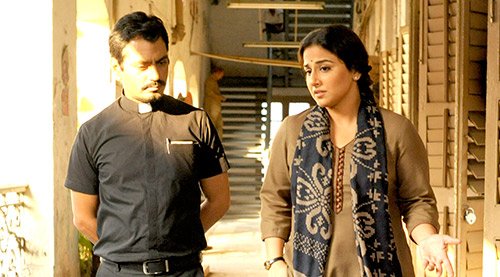
Nawazuddin Siddiqui was the police officer investigating the case 8 years ago, and botched it. He has since become a priest, and Amitabh (John) also torments him regularly about the cold case.
Amitabh neglects his disabled wife, the bills and regular life in his obsession to find justice for his granddaughter. He uncovers what he believes is new evidence in the case, and gets Martin (Nawaz) to accompany him to track down more clues.
Then another young child is kidnapped, and the details of the case seem to be an exact copy of the case of John (Amitabh)’s granddaughter. Vidya calls on Martin (Nawaz) to help her find the kidnapped boy.
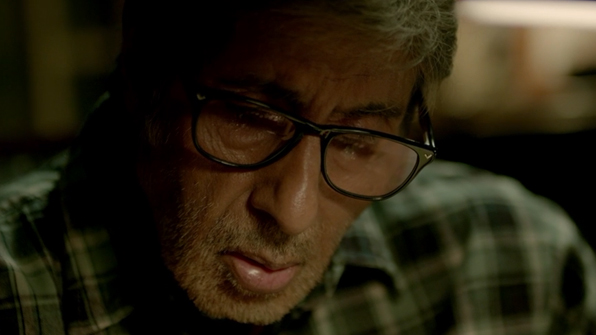
What this movie got right was the obsession that family members can fall into, especially the elderly, with an unsolved case. Our family happens to have a missing person/probable murder cold case. Having a tragedy like that hanging over a family can take a heavy toll. Amitabh lets all the despair and pain show in this movie. His wife, and every one urges him to just let it go, but he can’t. He just can’t.
Te3n is written and directed by Ribhu Dasgupta and produced by Sujoy Ghosh of Kahaani fame. It’s an authorized remake of the Korean film Montage, which I have not seen. Te3n is set in Calcutta, but just never manages to reach the level of suspense and tension of Kahaani, or true surprises. Here you have three of my favorite Indian actors in Hindi cinema, and while the film is good, it’s not as great as I was hoping it would be. The ending was a satisfying conclusion to the thriller, but I had some unanswered questions.
Amitabh’s John is fleshed out, but I was left wondering if it was just this one case that led Martin, Nawaz’s former cop character to become a priest.
After the searing Malayalam gangster film Kammati Paadam, I wanted something lighter to watch. Someone had recommended to me Athadu as their favorite Mahesh Babu film and it’s free on Youtube with subtitles. (Love you Telugu Cinema industry for doing that!). Athadu evidently means simply “He”.
It starts super violent. A young street kid murders someone, and then joins a gang. And then we see the now grown up Mahesh and there is more violence. I despaired at first as it was all this violence and blood — I’d had plenty of that with Kammati Paadam. Mahesh is Nandu, a killer – a stone cold hitman, and Sonu Sood is his getaway driver. He’s hired to stage an almost assassination of a politician, and is double crossed and chased for the murder. During his escape on a train, an innocent person is killed. And he takes on that victim’s identity, as the victim Pardhu was on his way to reunite with long lost family who hadn’t seen him in over a decade. Pardhu had been orphaned and his grandfather and family had been searching for him.
Mahesh arrives in the village, and is welcomed as the prodigal son returned. No one had seen Pardhu since he was a child, so they just say, “My you’ve grown tall!” and the like. Nasser plays the grandfather, and Trisha Krishnan is Poori, Pardhu’s cousin. Mahesh lays low and stays at the rural family compound for over a month. You can tell he’s never had a normal family life and that this is all new to him. And that’s when I realized, that this was going to totally be my catnip trope — killer disarmed by love and family!! With a heaping helping of taking on an identity and trying to blend into a family.
It’s like Witness crossed with The Professional crossed with Sommersby! (In a good way.)
Poori is infatuated with Pardhu/Mahesh. She is fairly immature and has obviously been very sheltered and pampered. She tells Mahesh that she is staying away from her sister meeting her potential bridegroom because she doesn’t want to overshadow her sister with her beauty. Mahesh tells her she is not beautiful — her family’s just been telling her she is.
Thus begins the teasing and mock fighting between the two which escalates to an accidental brushing of lips. (Swoon! — that’s both me AND the two characters swooning. Poori actually sinks to the floor in a heap from the emotional impact of it.)
Mahesh/Pradhu then fantasizes that he’s playfully nipping at Poori’s ear, and jolts back to reality in another favorite scene of mine. There’s some very nice song sequences as they each fall for each other.
Mahesh/Pradhu also comes to his grandfather’s aid in a land dispute with an evil neighbor. Cue the machete fight sequence! (It’s nearly a requirement in a Telugu film.) Mahesh finds out that the real Pradhu had played a mean trick as a kid, and gives money to the family anonymously so that their daughter can get an operation.
This film is filled with some of my favorite Telugu character actors. Nasser, as I mentioned, plays Pradhu’s grandfather. Prakash Raj, polyglot character actor of Hindi and many regional cinemas, plays the CBI officer on Nandu (Mahesh)’s trail. And Sunil, my favorite comedic Telugu character actor, plays the childhood friend of Pradhu. Mahesh confides in him that he’s not really Pradhu. The two comedy Uncles are in it, too, but not so annoying. Brahmanandam dares Mahesh to punch him in the stomach which he does so Brahmanandam actually made me laugh for once!
After one fight, Mahesh/Pradhu is fussed over by Pradhu’s aunt. She tends to his cuts on his hands, and then feeds him with her own hands as she’s afraid the spicy food will sting his cuts. This kindness affects Mahesh so much that he has to wipe the tears from his eyes. He’s been trying to quietly resist the family, because of course he’s not really Pradhu, their long lost nephew or grandson. He doesn’t think he’s worthy of any of their love and kindness. I was almost wiping the tears from my own eyes at this scene because you can see the loneliness of the life he had led up to this moment.
Poori was more than a little irritating in how immature her character was. She’s trying to be coquettish, but she really doesn’t know how. She pouts that Mahesh/Pradhu hasn’t told her she’s beautiful, and then came one of the best declarations of love I’ve seen in an Indian film. (I’ve posted the video starting at the scene below:)
He asks who said she wasn’t beautiful? “You did! You told me I wasn’t beautiful!”
Then he tells her that it was true. “Then I didn’t know you were so beautiful.”
“But I’m the same even now!”, she replies.
“I’m not. We see a moonbeam everyday. Only sometimes do we think it is beautiful. But it’s the same every day. The change is not there. It’s here!”, as he touches his heart. “I fought Buji…How else did you want me to express my love? I’m not like the others. I don’t know how to live. Only now I’m learning to live.”
I had to rewind and rewatch that scene a few times. So great.
One of Mahesh/Pradhu’s acts of generosity leads to Prakash Raj finding him, and his true identity being revealed. There is a fantastic scene that Mahesh has then with Nasser, the grandfather, that I won’t spoiler, but I really loved.
Then we’re back to action, as Mahesh goes back to the city to find out who the real killer was who framed him. There’s an amazing final fight scene, and great comeuppance for the villains. This is what Indian cinema does so well. Great action paired with emotional drama and romance. The plot is really nothing like Witness, but that is the film that I thought of immediately. Hardened man used to violence is forced to adapt to a rural family life. Total fish out of water, Nandu is not a cop — he’s who should be the villain, but we see through his actions that he has a marshmallow center.
This film goes right up there as one of my favorite Mahesh movies now. Really enjoyed it, and there were a few scenes that were truly magical.
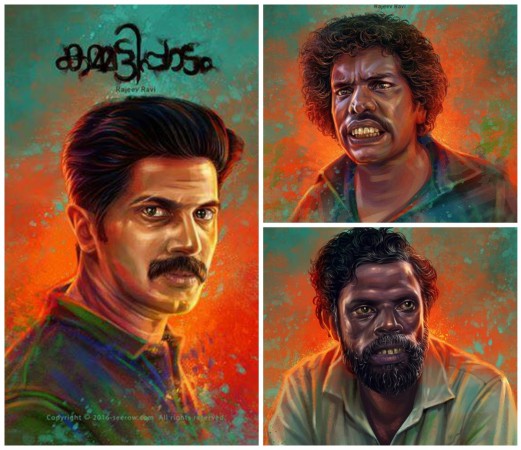
Kammatti Paadam is a gangster epic. This film has a lot of depth and meat to it. Dulquer Salmaan was amazing. I’m admiring his choices of films and roles this past year. He’s breaking into new ground and showing his acting chops outside the charming romantic lead type. The poster shows him present day as a salt and pepper haired 42 year old security guard living in Mumbai. (Yes, we see him doing security for a Bollywood film doing a street shoot!) Just a touch of gray to his hair and mustache. And I think he must have gained weight for the role. He just looked more like his father Mammootty than ever with that substantial thick mustache.
`
I looked up during the interval who the director is – Rajeev Ravi. He’s only directed a few Malayalam films, but he’s worked extensively as a cinematographer in Bollywood, with Anurag Kashyap especially. He was cinematographer on Bombay Velvet, Gangs of Wasseypur, Dev D, etc. And key in Malayalam cinema, he was cinematographer for Classmates. There were some really interesting shots — into plate glass windows, some shaky handheld work during action scenes, etc. It just was visually interesting and not all straight forward shooting as we sometimes see in Indian film.
The story is shown in a series of flashbacks after he gets a call in Mumbai from an old friend in Kerala who is in trouble. Dulquer is Krishnan, a Hindu middle class kid and the name of the movie is the neighborhood he grew up in and the name of his gang. We see his exposure to violence as a very young child, as he and his best friend Ganga see a local tough kill three men who challenge him. Then another actor plays Dulquer as a young teen and we see that he has fallen in love with a Dalit girl. The trouble is, so has Ganga. Ganga and the whole gang are dalit, and the ringleader is Balan, Ganga’s older brother. The actor who played Balan was incredible – newcomer Manikandan.
Balan is played by newcomer Manikandan
We see Krish’s descent into violence as a teenager. He gives a necklace to Anita, the dalit girl, and another reviewer pointed out that it was an echo of Michael Corleone in Godfather. I recognized a Nayakan poster in one scene, but evidently there are more references and posters to other Indian gangster films in flashbacks.
Krish is jailed after he saves Ganga from being arrested by slashing a cop with a knife/machete in an impulsive act, ending up killing the cop.
When he gets out of jail, it’s young Dulquer acting the part. We keep flashing back and forth in the narrative, and we can see present day Dulquer/Krish is injured with a bound torso, trying to keep conscious while riding a bus.
Balan, Ganga and the gang introduce Krish to their current operation — mostly transporting illegal hooch and bootlegging. They also are hired to run off some poor families who are refusing to sell to a real estate developer.
Balan’s grandfather confronts Balan with his shame that his relative could do this to their relatives and people, and then the grandfather dies of the shock and shame. This changes Balan and he wants to get out of the business as does Krish. But they know too much, and a new rival in the organization won’t let things stand. Balan is killed and Ganga blames Krish for it.
Ganga, Krish and the gang go after Johnny, the rival and then lay low after the altercation. Ganga tells Krish that he knows that Krish and Anita love each other but their families will never allow them to marry as it would be intercaste. He says that he will marry Anita and try to make her happy. Krish then goes to Mumbai. The mystery through much of the film is how if Ganga was his romantic rival and “stole” his girl, why would he leave everything to help him and look for him all these years later?
Vinayakan as the young and older Ganga
The guy who plays Ganga as an adult, Vinayakan was also fantastic. I just looked him up and he was the villain John in Kali! The director found some great actors, and your sympathies are with the Dalit and how they keep getting screwed. Their boss goes respectable and becomes a business tycoon in legal liquor and real estate, but the gang are left with nothing.
There is a final revenge scene, and Krish looks out over the city Ernakulam, Kerala. He says to the person he’s killing that the city was built on the thick black blood of the Dalit people. And then I realized that the idyllic country place from the childhood scenes, to the motley semi-rural shacks in the young men section to then the present day bustling city were all the same place. And the point of the movie was that this vibrant young new city was built on the Dalit community being dispossessed and they did it for quick money to their own community. That was probably obvious to the Kerala audience but I didn’t really get it until the end.
The women in the movie didn’t have much to do, much like many gangster pics. One interesting note was that Balan’s wife seemed to have become a don herself after his death (and more successful.) She assists Krish to find the answers at the end. And there is an unrequited romance for Krish, and a whisper of a song motif for them, but no full fledged song numbers at all. It was very much parallel cinema. I’m guessing it’s much like Gangs of Wasseypur (which I haven’t seen yet), Kerala version.
Krish is our entre to their world, but he’s more a witness to what happens to the Dalit community. He’s still middle-class and Hindu in the end and can move to Mumbai to start over, unlike the rest of the gang.
The film felt long to me, and I wished it had been edited a little tighter. (The filming ended in March evidently.) It’s a sprawling gangster epic in the mode of Nayakan, Godfather, Casino, etc. It’s not my favorite type of film. So, so violent. Shockingly violent in several parts. The acting was great, but it’s a story of brothers of circumstance if not of blood or caste. It’s the story of Ganga and Balan, and also Krish.
I admire this movie very much, but it’s not something I want to see over and over again. It’s just very dark and violent and searing. It was hard to see Dulquer be so violent in Kali, and this is even steps beyond that. It’s not a silly action Masala movie. He does the action scenes well, but he’s not a hero.
I thought we were seeing Dulquer play an adult in Kali, but this film shows him really, truly coming of age. I’m excited to see him take on that mantle, and looking forward to see what roles he’ll take on next.
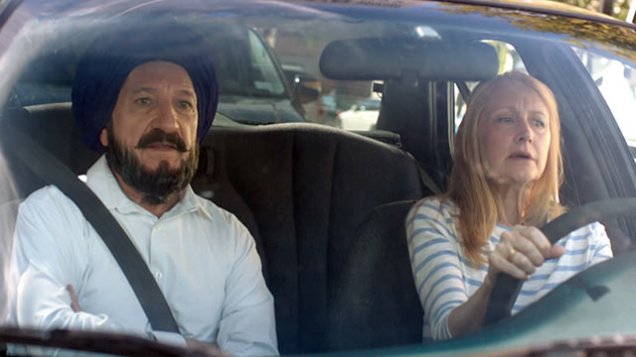
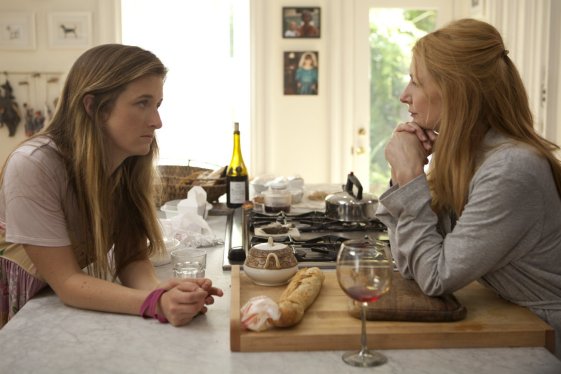
Learning To Drive is that rarest of films, one produced, written, edited and directed (Isabel Coixet) by women. The film opens with Wendy (Patricia Clarkson) and her husband Ted (Jake Weber) arguing in the back of a taxi driven by Darwan (Ben Kingsley). Ted has been cheating on Wendy and is leaving her as she tearfully begs him to stay. Darwan is very uncomfortable leaving the distraught Wendy at her apartment. She has left a package in the cab, and he returns the next day to give it back. This time he’s driving his driving school car, and she asks for his card.
Wendy, a book critic, lives in New York City and has never learned to drive. She always had Ted to drive her to visit her daughter who lives in Vermont, or her sister (delightfully played by Samantha Bee) who lives in Connecticut. The inability to drive metaphor for her live is hit a bit over our heads, but still, Patricia Clarkson is such a fantastic actress that she elevates whatever script she’s in.
Grace Gummer (Meryl Streep’s daughter) plays Wendy’s daughter
When Wendy’s daughter tells her she’s going to be moving to Vermont, far from a train station, that pushes Wendy to call Darwan and start driving lessons.
The film is more focused on Wendy’s life, but does give us background on Darwan. We learn he is a Sikh immigrant here in the US for political asylum. The police raid his home and his nephew Preet hides in a cupboard, which I was gathering meant he had overstayed his student visa? I wanted to know a bit more about the nephew’s story, and not just because the actor was a dreamboat.
Avi Nash as Preet (Darwan’s nephew)
There were some great cameos in the ninety minute dramedy film. John Hodgman is a car salesman, and the most delightful surprise is that Samantha Bee plays Wendy’s suburban sister. She has some great zingers as she urges Wendy to move on from Ted.
Darwan’s sister arranges for him to marry a woman from his village. He is disappointed to find that Jasleen is not educated, and is timid in her new urban home.
Darwan and Jasleen’s wedding
Darwan tells Jasleen (Sarita Choudhury) that she is in America now and they will only speak English to each other. This leads Jasleen to hardly talk at all. Jasleen and Darwan are supposed to be Punjabi, and it would have been more natural for them to at least speak some of that language in private. In reading about the film after watching it, I learned that neither Ben Kingsley or Sarita Choudhury can speak Punjabi. Still, Sarita Choudhury was great in her scenes as Jasleen conveying much just through her expressions.
Darwan and Wendy develop a friendship over their driving lessons, and because she rear ends another car during a lesson, she ends up coming to the airport with him to pick up his bride. He contrasts the intellectual conversations he can have with Wendy to his home life with his new bride, still basically a stranger to him.
I enjoyed this “almost” romantic comedy. I watched it on Amazon Prime. It’s free to watch if you have a Prime membership. Four stars out of five mainly for the wonderful performances.
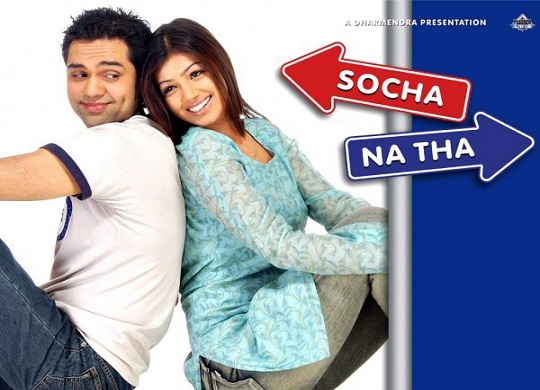
Dharmendra chose well for his nephew Abhay Deol’s debut film, Socha Na Tha [I Never Imagined]. He picked the talented director Imtiaz Ali who gave the falling-in-love-with-the girl-your-parents-picked-for-you Indian romance a fresh modern feel. This was Imtiaz Ali’s first film, after directing in television. Socha Na Tha was not a commercial success, but it gained critical praise at the time, and he followed it with Jab We Met, one of the all time favorite Hindi romance films.
Abhay plays Viren, a young man who has returned to India from University in the US, but has not started work yet. His family despairs of him growing up, and his father puts his foot down. He’s 24, and it’s time he was married. He agrees to meet a girl his family chooses, but he has a secret romance with a Christian girl, Karen. He’s on the verge of proposing to Karen.
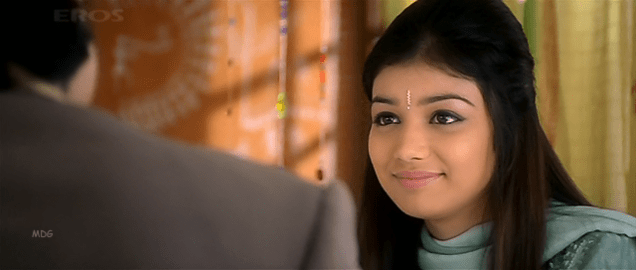
Viren and Aditi (Ayesha Takia) first meet at her family home. Ayesha is absolutely adorable. She explains to him that she doesn’t want to get married either, but he has to be the one to refuse her, as she can’t. Once they get that out of the way, they have a wonderful easy conversation. From the little we’ve seen of Viren’s interactions with Karen, he has a rapport with Aditi immediately and an ease that he doesn’t with his years long girlfriend Karen.
When Viren refuses Aditi as a potential bride, the families grow hostile to one another, as Aditi’s family feels Viren led her on. They meet by chance in a mall, and he explains asks for her help in convincing his girlfriend’s parents to let her go on a holiday trip to Goa. Aditi tells her parents that Karen is attending her wedding, and Karen tells hers the opposite. But Karen joins the party a few days late. Viren and Aditi spend lots of time together and grow closer and friendlier. When Karen arrives, she senses what’s happening. Aditi and Viren spend one whole night talking and fall asleep together on the beach.
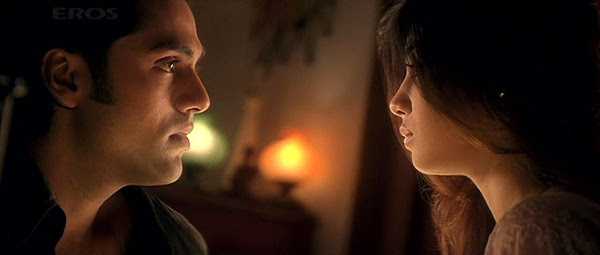
Once they return, Viren does propose to Karen but his family is opposed to him marrying a Christian. He’s convinced it will never be resolved and meanwhile is obsessing over video he took of Aditi in Goa. He goes to see Aditi, and almost Romeo like sneaks up her balcony into her room. What comes next is one of the most romantic scenes I’ve ever seen in Hindi film. It’s not that Abhay is such a great actor at this early point in his career. It’s all Imtiaz Ali’s skill in directing this scene. It’s become one of my all time favorites.
Viren says to Aditi, “I thought I was in love with Karen. But if that was love—what is this?”
Things become a tangled mess for Abhay, as his parents suddenly agree to his marriage with Karen and now he’s stuck.
The last part of the film is hard to watch because Viren is so indecisive and takes a long time to tell people what he wants to do with his life. He doesn’t want to disappoint his family, and can’t figure a way out. He needs to grow up, and so does Aditi.
Margaret at Don’t Call It Bollywood gives a great analysis of Socha Na Tha and how it reaffirms arranged marriage. Because in the end, this film is showing that the best partner is the one your family chose for you. That they know you best. It was her post that led me to buying this film and watching it. I’m so glad I did. I loved it and how natural and modern Imtiaz Ali made this story feel. Abhay Deol was fantastic in this even if I wanted to wring his neck at several points. Ayesha Takia was wonderful, and I liked how Karen (Apoorva Jha) wasn’t a stereotypical evil ex. She is actually instrumental in getting Viren and Aditi back together. Even the stern father, we see really loves Viren, and has good reason for wanting his son to grow up already. (Since I have a son about the same age who is finding himself, I can relate, much more than I want to.)
Four and a half stars out of five. Imtiaz, please give us more great romances like Socha Na Tha and Jab We Met with these great real characters!
I have just recently discovered Mahesh Babu, and I was really excited to be able to see my first Mahesh Babu film on the big screen. I have been listening to the Brahmotsavam soundtrack non-stop, especially Vacchindi Kada Avakasam, the first song in the movie. The full song sequence did not disappoint!
I have very mixed feelings about the movie. The songs and the soundtrack are GREAT. I mean, I saw a movie with an A. R. Rahman soundtrack this week that didn’t impress me half as much (the Tamil Sci-fi 24)! And the song number sequences were amazing. The dancing, everything. I’m going to be downloading most of the soundtrack. Vachhindi Kada Avakasam is still my favorite, but the title track and several other songs are fantastic.
I felt like this was one of those movies where they assembled all the actors, but didn’t really have a script. I can hear the pitch to Mahesh – It will be about family! Two romances with your romantic leads from other films! Great location shots all over India! Scenic! Gorgeous! Great music!
And….. then the plot was an afterthought.
I have not seen Seethamma Vakitlo Sirimalle Chettu, writer/director Srikanth Addala‘s previous hit film with Mahesh Babu. Three Indian guys after the movie told me that one is much better, and one I should definitely see.
Brahmotsavam (which I think means grand celebration) is very much like the Hindi classic family films Hum Aapke Hain Kaun (HAHK) and Hum Saath Saath Hain (HSSH). Not a lot of plot. Lots of family.
The drama, such as it is, is that the Sathyaraj, father of Mahesh, loves big celebrations and family gatherings. He is wealthy and has a paint company that he started with 400 rupees given to him by his wife’s family. His brothers work for him at the company. But there is one brother-in-law who is bitter and resentful. And this is where the non-specific relationship names in the subtitles were tripping me up. When Mahesh called the mean uncle, “uncle”, it could have been because he was his father’s partner and it took me quite awhile to figure out that he WAS a family uncle. I don’t know the Telugu terms as well as I do the Hindi yet.
Mean uncle wants Mahesh to marry his daughter. But Mahesh is falling for Kajal who is visiting for the holiday? Her relationship to Mahesh was really unclear. I couldn’t catch if she was a cousin, her father’s relationship to Mahesh’s father I couldn’t figure out. I think she was the daughter of a family friend.
I was very, very confused. We have this “wedding scene’ which I later figured out was a holiday ritual. Family on two sides of a room with a god/goddess statue at the center front. And the family members argue in turn like they are arranging the marriage of the gods. “What’s this about this Radha we’ve heard about?? Will the groom be faithful?” Banter like that. The scene is repeated later in the movie which is when I finally figured it out. The first time I literally could not tell if they were arguing and arranging Mahesh’s marriage or his sister’s or WHAT the heck was going on. It was a scene I have never seen in an Indian movie before, but I haven’t seen very many Southern Telugu films.
What was good in the film were the two romances with Mahesh. The first is with Kajal, and their teasing flirtation, and couple of songs were fantastic. This song made me swoon.
She goes on a big family trip with Mahesh’s family, which reminded me very much of the family trip scenes in Hum Saath Saath Hain. Cue GORGEOUS scenery.
And me mouthing that Liz Lemon line over and over, “I want to go to there!”
SPOILERS, SPOILERS, SPOILERS ahead.
Their break up is over something I have never seen in an Indian movie. Kajal breaks it off because she can see his large family means so much to Mahesh, but she just can’t take so many people all at once all the time. (And she seems to have a career in Australia, too.)
There was a family argument with mean uncle and Mahesh’s father — and then this super weird confusing scene where Mahesh is consoling his despondent father. And it turns into like a nightmare dream state and Mahesh is running around the house — and the father is dead? I mean it was not obvious, and it took me awhile of dialogue after that to figure it out! The subtitles might have not served me well, but it was damned confusing. It was a missed opportunity for drama, in my opinion.
So now Mahesh is lonely, his uncle won’t reconcile, and Kajal left him.
Enter Samantha, a friend of his sister’s in London! She comes to the house in a very funny scene, introducing herself as the sister’s friend and can she stay. Sure! Um, can I bring in to stay some friends I met on the way? Sure! An entire BUSLOAD of people come into the house!! It was very amusing. Samantha Prabhu was in the Tamil film 24 I saw earlier this week, and she was better here, but not exceptional.
She is the life and brightness that Mahesh needed. She obviously loves having more and more family and people around, which is just what he likes. For some unknown reason, he brings her with him on a quest to find “the generations” — his roots and to meet all his distant relatives. This leads to traveling ALL OVER INDIA finding distant cousins, Nasser is one, and other recognizable character actors. This part was super super confusing to me. The cities visited were stunning and gorgeous, but it was hard to tell why they went all those places.
And at the end he invites them all to his uncle’s daughter’s wedding, thus showing respect?? And they reconcile and Mahesh begs to live in his uncle’s house. Wha???
What really, really irked me was that when Kajal breaks up with Mahesh, she kisses him and hugs him. Mean uncle sees this and leaves the family trip in a huff — because he had wanted his daughter to marry Mahesh. He doesn’t know that Kajal was breaking it off. Now, what happens next was confusing in the movie, but I think he beat his own daughter. And Mahesh goes to the hospital and the daughter tells Mahesh that her father (mean Uncle) was upset when he saw the Kajal kiss. She has bruises all over one arm, and her ankle is being bandaged.
So the whole movie Mahesh is trying to reconcile with the mean uncle. He is not ostracized for harming his daughter. He arranges a good marriage for her at the end– I’m not sure we ever saw the groom, and frankly up till the end I couldn’t tell if Mahesh was the groom and was giving up Samantha to patch up the family. It was that confusing! But I know this is all “Indian family values” like in HAHK, but I was really bothered about it as I’ve been thinking it over in the hours since I left the theater. WHY should family harmony trump all, and there be no backlash for the daughter beating. It rankles me that Mahesh felt he needed to literally bow down to this uncle to make peace.
And Mahesh has a sister we see on video chat, but she doesn’t ever reappear even after the father’s death. Another missed opportunity for drama.
I was so confused at the end! As I walked out of the theater three young men stopped me and asked how I liked it, and I admitted that I was confused but loved the soundtrack. And they said it was all about connecting to the generations at an Indian wedding, but they agreed that the plot was confusing to them, too. That made me feel somewhat better because I thought it was just me, and my ignorance of the Telugu language and the Southern rituals and all. But these three guys said the plot was not the best for them either.
Brahmotsavam was a big letdown for me. This movie was not as great as I was hoping it would be. I will read up on what the heck the plot was about, and then go back to see it again when the prices are lower. (It was $18 for the opening day.) I did lovethe song sequences a lot, and would like to see them again on the big screen. The colors, the scenery, the chemistry with Kajal, the music, were all fantastic. It’s just really a shame that there wasn’t a worthy enough plot and drama to hold it all together. I contrast this to Kapoor and Sons which was such a fantastic family drama with a stellar script. I shouldn’t have to come out of a movie and then go online to figure out what the plot was that I just saw!
I give Brahmotsavam two and a half stars out of five, mainly for the music alone and the romance with Kajal.
Sci-fi films are not that common in Indian Cinema at all. (I still haven’t seen Rajnikanth’s Robot which is sitting in my DVD pile.) 24 was a really interesting film, because it used some of the conventions of sci-fi films I’m used to from the West, but added in the family and mythic elements of Indian cinema. The film stars Suriya in a triple role. This is my first Suriya film. Looking him up later, he is famous for originating the role of the cop in Singam (which Ajay Devgn remade into the Hindi Singham).
In the picture above Suriya plays the inventor dad who makes an almost steam punkesque time machine watch. It can only go backwards a maximum of 24 hours, thus the movie title. The middle character is the evil brother of the inventor — very Indian!
Then the left is the 26 year old son of the inventor, present day 2016 Mani. Nithya Menon of OK Kanmani has a brief role as Priya, wife of inventor, mother of Mani. Samantha Prabhu played the love interest for Mani and was just okay.
Suriya was impressive. He is a talented actor because he really, really pulled off three separate characters with the three roles. And there are scenes of him being one character and pretending to be another which is hard to do, and he totally nailed it.
There’s a whole plot with baby Mani being entrusted to a young girl who raises him on her own as a single mother. I’m thinking there’s a whole Mahabharata story I’m missing that it ties to that would be obvious to the Tamil audience. (Asked a friend and the foster mother is supposed to be Yashoda who raised Krishna.) There’s also elements of karma and fate as the time travel machine watch and a key find their way to Mani.
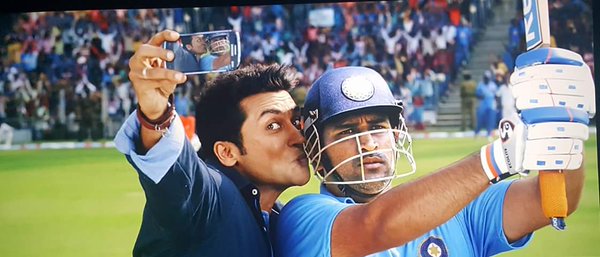
What was great about the film is that when Mani gets the time travel machine watch to work (he’s a watch repair man, fortuitously!), he first uses it to romance the girl. He’s almost like a young superhero geeking out over his new found super powers. Those scenes were really fun. He can also freeze time, and uses that to take a selfie with Dhoni in the middle of a cricket match. Watching him explore the powers of the time travel machine, explains what it can do, and how the time travel is going to work (and its limits) to the audience in a clever way.
I really love time travel movies, especially when they are used in romantic films. Outlander is hot right now, but who can forget Christopher Reeve in Somewhere In Time? He had no time machine, just hypnosis and the power of his love!
There have been several adaptations of H. G. Wells novel The Time Machine, notably the 2002 The Time Machine directed by Simon Wells, great-grandson of the author and starring Guy Pearce.
In The Time Machine, Wells or his avatar finds love with a primitive girl as civilization has collapsed in the distant future. Yeah, there’s none of that kind of nonsense in 24, thankfully. It’s a story of personal revenge in one family. But while Suriya was great as the villain, hell bent to get the time machine watch to try to cure himself — it was never explained why he hated his inventor twin so much. I wish a little less time had been spent on the romance plot towards the end, and some time had been given to the back story of the twin brothers. Of course, the filmmakers have left it open to a prequel or a sequel.
I thought the CGi and special effects were good, and the music was by A.R. Rahman. Not his best score ever, and I’m not running out to download the songs, but good. I would hesitate to bring very young children to the film as one character gets his hand cut off. Overall, an enjoyable action film, especially for the performance of Suriya in the three roles. Four stars out of five.
24 is out in Tamil, and a dubbed Telugu version. My theater had both.






 David escapes and becomes part of the Loner band in the forest where he meets Rachel Weisz. They have to pretend to be a couple to venture into the city for supplies, and David enthusiastically falls into the playacting and kissing. The young woman leader of the Loners is just as strict in her no fraternizing rules as the manager of The Hotel had been with her coupling rules. Farrell and Weisz plot together to escape.








 This film goes right up there as one of my favorite Mahesh movies now. Really enjoyed it, and there were a few scenes that were truly magical.

















 Pardesi Reviews